 Turkish
 English
 Arabic

Search and Rescue Tent Technical Specifications
10-07-2019
11:36
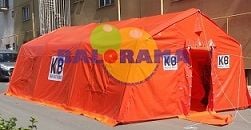
Search and Rescue Tent Technical Specifications
1. The inflatable tent will be designed so that two people can easily set it up in 8-15 minutes.
2. Structures will be resistant to severe weather conditions (storms, blizzards, heavy rainfall) and will have storm relief connections.
3. The structures will provide adequate comfort to the user during harsh winter conditions and extremely hot climates.
4. The inflatable tent will have lighting, heating and cooling devices, as well as power connection ports for connecting all kinds of electrical and electronic devices.
5. The organization's logo and name will be written on both sides of the tent.
6. The columns of the buildings shall have a sufficient number of hanging loops for lighting and material suspension.
7. Main Support: The inflatable tube fabric will be European Valmex material, weighing 900g +/- 30g per m². The system will have at least two safety valves. Air can be released from the valves in case of excessive pressure. The system will consist of a support system of 30cm diameter columns and beams.
| Coating Type: | PVC |
| Weight : | At least 900 g/m² (± 1%) |
| Tensile Strength (warp/weft): | At least 2900/2900 n/50mm |
| Tear Strength: | 250/250 n |
| Adhesion strength of the fabric to PVC: | 20 n/cm |
| Resistance to cold: | Minimum -25°C |
| Heat resistance: | At least 65°C |
| Lightfastness: | >5 |
| Fracture resistance: | At least 95,000 |
| Basic material structure: | Give up |
| Thread count: | 1100 dtex |
| Weaving method: | 1/1 |
| Water resistance: | 8000mm water column |
8. Outer Fabric: The inflatable tent's fabric will be at least 450g polyester and rope woven, and will have flame-retardant properties. The color will be orange or red.
Material type: PES fabric with PVC/acrylic/PUR coating. | Suitable |
| PES fabric weave type: 1/1 plain weave | Suitable |
| UV stabilizers will be used. | There is |
| Tarpaulin width, cm ≥ 150 | > 150 |
| Tarpaulin area density (grammage), g/m² 435±15 | 449 |
Dimensional stability (+70°C/24 hours) shrinkage: ≤ 2% Elongation: ≤ 1% | <0.3 <0.3 |
| Heat aging (+70°C / 24 hours) | Suitable |
| Cold aging (-40°C / 6 hours) | Suitable |
| Weight loss in hot aging is ≤ 5%. | 0.9 |
| Tarpaulin waterproofness, mm water ≥ 2000 | >10000 |
| Non-flammability: burning time after flame extinguishment, seconds: ≤ 6 Burning time, seconds: ≤ 12 Damage rate, %: ≤ 60 | <1 <1 <10 |
| Friction resistance (280a sandpaper), speed ≥ 9000 | >9000 |
| Tensile strength, manufacturing direction, n ≥ 1500 Perpendicular to the direction of production, n ≥ 1500 | 1872 1740 |
| Tear strength, manufacturing direction, n ≥ 180 Perpendicular to the direction of production, n ≥ 180 | 256 282 |
| Folds should not stick together during folding. | Suitable |
9. Base Cover: The base fabric of the inflatable tent will be at least 620g matte, non-slip patterned, polyester and rope woven, and will have flame-retardant properties.
10. Extras: The tent will be manufactured using heat-sealed and stitched methods, and a second heat-sealed layer will be applied to the stitched areas. The tent's outer fabric will include hot air fan and electrical installation entry points, as well as front and rear ventilation openings.
11. Dimensions: … cm x … cm (approximate outer dimensions).
12. Windows: The tent has 4 windows, approximately 80x60 cm ± 5%, with mosquito nets, removable acetate glass, and curtains. The mosquito nets will be Teflon-coated and flame-retardant.
Figure 13 : The tent's top surface will be pyramid-shaped to prevent rain and snow accumulation and ensure drainage. The tent must have two doors; the entrance door and the other door must be designed and constructed to connect to a second tent. The door panel fabric will have the same technical specifications as the shelter's outer fabric. The door panel will be mounted as a single piece to the outer fabric, and its upward and downward movement will be facilitated by two large-toothed textile zippers on the right and left sides of the door panel. The door fabric, which is gathered upwards for entry, should be able to be secured to the front upper surface of the shelter with two belt buckle straps.
14. Fixing and Supporting Elements: At least 8 iron stakes will be provided for externally fixing and tensioning the shelter. The stakes will be at least 14 mm in diameter and at least 25 cm in length. Along with the stakes, at least 30 meters of UV-resistant 8 mm thick tensioning rope will be provided. For transporting and storing the shelter, a carrying bag made from the shelter's base fabric with at least 4 handles will be provided. The carrying bag must be large enough to hold all the shelter's attachments and materials.
15. Tools and Accessories:
Inflation Fan:
The fan, which will provide inflation and vacuuming of the automatic columns and beams of the shelter, will be electric-motor powered. The fan housing will be made entirely of ABS material. The fan must be able to inflate all columns and beams without interruption during inflation. The fan's input voltage will be 220V-240V. The fan's operating pressure should be 2.8 psi. The fan's airflow will be 800 l/min.
Repair Kit:
To enable immediate intervention in case of any bursting or puncture in the load-bearing columns and beams of the shelter, the following repair kits will be provided: 1 oval repair patch with a minimum diameter of 15 cm (for fabric-like structures on columns and beams), 1 oval repair patch with a minimum diameter of 20 cm (for fabric-like structures on columns and beams), 1 square repair patch of 15x15 cm (for fabric-like structures on columns and beams), 1 quick-drying adhesive and a brush.